
JavaScript 原型鏈(Prototype Chain)


前言

物件導向程式設計(OOP)的基本概念是使用物件的方式來表示,透過類別(class)的函式建構式(function constructor)可以產生物件實例(object instance)。

JavaScript 並非真正的物件導向 (OO) 語言,它是一個以原型為基礎 (Prototype-based) 的語言。因為沒有 Class,而是透過 「原型」(prototype) 來實現繼承實作。

建構式

在 JavaScript 中,一個 Function 是不是建構式並不是取決於它的宣告方式,而是取決於它是不是用 new 來執行的。如果是用 new 執行一個 Function 時,我們就稱做這種呼叫為 建構式呼叫。當我們用建構式呼叫去執行一個 Function,這個 Function 就會被當作建構式。

使用 new 建構式呼叫的時候,實際上會有幾件事會被執行:

  • 首先會新建出一個物件。
  • 將物件的 .__proto__ 指向建構子的 prototype ,形成原型串鏈。
  • 將建構子的 this 指向 new 出來的新物件。
  • 回傳新建物件 ( 如果建構式本身沒有回傳東西的話 )。

先來看一下 function constructor 的實際應用,透過 function 的方式來建立一個新的物件,如果我們想要建立出同屬性名稱但不同屬性值的物件內容,我們可以把物件的屬性值變成參數,如此就能透過此 function constructor 建立出許多不同的物件:

1
2
3
4
5
6
7
8
9
10
11
12
13
14
15
16
function Person(firstName, lastName, age) {
this.firstName = firstName;
this.lastName = lastName;
this.age = age;
this.log = function () {
console.log(this.firstName+' '+this.lastName+ ', age:' + this.age);
}
};

var roman = new Person('Roman','Gonzalez', 18);
roman.log(); // Roman Gonzalez, age:18

var bobby = new Person('Bobby','Lashley', 20);
bobby.log(); // Bobby Lashley, age:20

console.log(roman.log === bobby.log) // false

name 跟 age 這兩個屬性在每一個 instance 都不一定會相同,而 log 這個 method 其實都在做同一件事情,而且還佔用了兩份空間。意思就是他們其實是兩個不同的 function 。

因為每一個 instance 彼此之間是可以共享方法的,所以我們可以透過把 log 這個 function 抽出來,指定在 Person.prototype 上面,這樣所有用 Person 建構出來的 instance 都可以共享這個方法,將可以有效減少記憶體占用的問題。

1
2
3
4
5
6
7
8
9
10
11
12
13
14
function Person(firstName, lastName, age) {
this.firstName = firstName;
this.lastName = lastName;
this.age = age;
};

Person.prototype.log = function () {
console.log(this.firstName+' '+this.lastName+ ', age:' + this.age);
}

var roman = new Person('Roman','Gonzalez', 18);
var bobby = new Person('Bobby','Lashley', 20);

console.log(roman.log === bobby.log) // true

共用的屬性或方法,不用每次都幫實體建立一份,提出來放到 prototype 即可。

以下是嘗試存取屬性時會發生的事:

1
2
3
4
5
6
7
8
9
10
11
12
13
14
15
16
17
18
19
20
21
22
23
24
25
26
27
28
// 利用含有 a 與 b 屬性的 f 函式,建立一個 o 物件:
let f = function () {
this.a = 1;
this.b = 2;
}
let o = new f(); // {a: 1, b: 2}

// 接著針對 f 函式的原型添加屬性
f.prototype.b = 3;
f.prototype.c = 4;

console.log(o.a); // 1
// o 有屬性「a」嗎?有,該數值為 1。

console.log(o.b); // 2
// o 有屬性「b」嗎?有,該數值為 2。
// o 還有個原型屬性「b」,但這裡沒有被訪問到。
// 這稱作「property shadowing」。

console.log(o.c); // 4
// o 有屬性「c」嗎?沒有,那就找 o 的原型看看。
// o 在「o.[[Prototype]]」有屬性「c」嗎?有,該數值為 4。

console.log(o.d); // undefined
// o 有屬性「d」嗎?沒有,那就找 o 的原型看看。
// o 在「o.[[Prototype]]」有屬性「d」嗎?沒有,那就找 o.[[Prototype]] 的原型看看。
// o 在「o.[[Prototype]].[[Prototype]]」是 null,停止搜尋。
// 找不到任何屬性,回傳 undefined。

增加原生原型的屬性和方法

上面都是設定自己建立的物件原型,也能修改預設的原生原型,但不要不小心把原本內建的屬性或方法給無意間覆蓋掉。

例如在 Array.prototype 上面加上函式:

1
2
3
4
5
6
7
8
9
10
11
12
13
14
15
16
17
18
19
20
21
Array.prototype.push("Cyting")

var myname = [];
myname[0];    //"Cyting"


var ting = [];
ting[0];     //"Cyting"

Array.prototype.top = function () {
return this[0];
};

myname.top(); //"Cyting"
ting.top(); //"Cyting"

String.prototype.isLengthGreaterThan = function(limit){
return this.length > limit;
}

console.log("Cyting".isLengthGreaterThan(4)); // True

在 Array.prototype 中 push 一段字串進去,接著新增 top 函式回傳字串內容;只要宣告出陣列型別的資料型態,都會有該字串內容,也都能呼叫 top 函式。

修改 Prototype 方法

我們可以修改某個 function constructor 的 prototype 內容,當改變了該函式建構式中 prototype 內的方法,那麼所有根據這個建構式所建立的實例(不管是修改 prototype 之前或之後所建立的實例),都會套用更新後的方法:

1
2
3
4
5
6
7
8
9
10
11
12
13
14
15
16
17
18
19
20
21
22
function Person(firstName, lastName, age) {
this.firstName = firstName;
this.lastName = lastName;
this.age = age;
};

Person.prototype.log = function () {
console.log(`Hi ${this.firstName} ${this.lastName}`);
}

var roman = new Person('Roman','Gonzalez', 18);
roman.log(); // Hi Roman Gonzalez
var bobby = new Person('Bobby','Lashley', 20);
bobby.log(); // Hi Bobby Lashley

// 修改原本的 log 方法
Person.prototype.log= function() {
console.log(`Hello, ${this.firstName} ${this.lastName}`);
}

roman.log(); // Hello, Roman Gonzalez
bobby.log(); // Hello, Bobby Lashley

原型鏈 Prototype Chain

當物件試圖存取一個物件的屬性時,其不僅會尋找該物件,也會尋找該物件的原型、原型的原型……直到找到相符合的屬性,或是到達原型鏈的尾端。

所有的物件裡面都會包含原型(prototype)這個物件,在 JavaScript 中這個物件的名稱為 __proto__ 。如果在原本的物件中找不到指定的屬性名稱或方法時,就會進一步到 __proto__ 裡面來找。

以上面 var roman = new Person(‘Roman’,’Gonzalez’, 18); 為例,當呼叫 roman.log() 方法,因為 roman 這個 instance 本身並沒有 log 這個 function,而 roman 是 Person 的 instance,所以如果在 roman 本身找不到,就會嘗試從 Person.prototype 去找。

我們想要取得某個物件的原型物件時,就可以透過以下兩個方式:

1
2
3
4
5
//可以使用 .__proto__ 來取得 [[Prototype]] 
roman.__proto__ === Person.prototype // true

//也可以用 Object.getPrototypeOf(..)來取得 [[Prototype]]
Object.getPrototypeOf(roman) === Person.prototype // true

roman 的 __proto__ 會指向 Person.prototype ,當發現 roman 沒有 log 這個 method 的時候,JavaScript 就會試著透過 __proto__ 找到 Person.prototype ,去看 Person.prototype 裡面有沒有 log 這個 method。

假如 Person.prototype 還是沒有呢?那就繼續依照這個規則,去看 Person.prototype.__proto__ 裡面有沒有 log 這個 method,就這樣一直不斷找下去。直到該物件的 __proto__ 為 null 為止,意思就是找到最上層了。

而上面這一條透過 __proto__ 不斷串起來的鍊,就稱為原型鍊。透過這一條原型鍊來呼叫自己 parent 的 method,讓 JavaScript 達到類似其他物件導向語言般的類別、繼承功能。

1
2
3
4
5
6
7
8
// roman.__proto__ 會指向 Person.prototype
console.log(roman.__proto__ === Person.prototype) // true

// Person.prototype.__proto__ 會指向 Object.prototype
console.log(Person.prototype.__proto__ === Object.prototype) // true

// Object.prototype.__proto__ 會指向 null,這就是原型鍊的頂端了
console.log(Object.prototype.__proto__) // null

hasOwnProperty

如果想知道一個屬性是存在 instance 身上,還是存在於它屬於的原型鍊當中,可以用 hasOwnProperty 這個方法:

1
2
3
var roman = new Person('Roman','Gonzalez', 18);
console.log(roman.hasOwnProperty('log')); // false
console.log(roman.__proto__.hasOwnProperty('log')); // true

hasOwnProperty 只會檢查該物件,而不會檢查整條原型串鏈;可以透過迴圈來列出整個原型鏈且為可列舉的屬性;prop 是自訂的變數,會把該物件的屬性存在這個變數中,接著讀取下一個屬性,重覆直到沒有屬性為止,透過 for…in 把該物件中的所有屬性名稱和屬性值都列出來,列出的項目也包含被添加過的屬性或方法:

1
2
3
4
5
6
7
for (var prop in roman) {
console.log(prop);
}
//firstName
//lastName
//age
//log

instanceof

檢查物件是否為指定的建構子所建立的實體,位於 instanceof 左邊的運算元是物件,右邊的是函式,若左邊的物件是由右邊函式所產生的,則會回傳 true,否則為 false。

1
2
3
roman instanceof Person    // true
roman instanceof Object // true
roman instanceof Array // false

A instanceof B 就是拿來判斷 A 是不是 B 的 instance 只要能在 A 的原型鍊裡面找到 B 的 prototype,就會回傳 true。

isPrototypeOf

與 instanceof 不同之處只在於運算元的資料型別不同而已,但功能是相同的。

1
2
3
Person.prototype.isPrototypeOf(roman)  // true
Object.prototype.isPrototypeOf(roman) // true
Array.prototype.isPrototypeOf(roman) // false

如果 A.isPrototypeOf(B) 返回 true 則 B instanceof A 一定返回 true 。

Object.prototype

當我們嘗試在某個物件存取一個不存在該物件的屬性時,它會繼續往它的「原型物件」[[prototype]] 去尋找,直到找到 Object.prototype 才停止。

1
2
3
4
5
6
7
8
9
10
11
12
13
14
// 這兩個互為彼此的 instance
console.log(Function instanceof Object); // true
console.log(Object instanceof Function); // true

// Function 的 __proto__ 會指向 Function.prototype
// Function.prototype 的 __proto__ 會指向 Object.prototype
console.log(Function.__proto__ === Function.prototype); // true
console.log(Function.__proto__.__proto__ === Object.prototype); //true

// Object 的 __proto__ 會指向 Function.prototype
console.log(Object.__proto__ === Function.prototype); // true
console.log(Person.__proto__ === Function.prototype); // true
console.log(Function.prototype.__proto__ === Object.prototype) // true
console.log(Object.prototype.__proto__); //null

constructor

每一個 prototype 都會有一個有 constructor 屬性,而這個屬性會指向構造函數,例如 Person.prototype 的構造函數就是Person。

1
2
3
4
5
6
7
8
9
10
11
12
13
14
15
16
17
18
19
function Person(firstName, lastName, age) {
this.firstName = firstName;
this.lastName = lastName;
this.age = age;
};

Person.prototype.log = function () {
console.log(`Hi ${this.firstName} ${this.lastName}`);
}
var roman = new Person('Roman','Gonzalez', 18);


// 往原型鍊去找
console.log(roman.constructor === Person); // true
console.log(roman.hasOwnProperty('constructor')); // false

// Person 的 constructor 就是 Person
console.log(Person.prototype.constructor === Person); // true
console.log(Person.prototype.hasOwnProperty('constructor')); // true

X.prototype.constructor === X ,將 X 用 Function, Person, Object 帶進去都會是 true。

Object.create() and new operator 差異

以下為使用 Object.create 方式:

1
2
3
4
5
6
7
8
9
10
var dog = {
eat: function() {
console.log(this.eatFood)
}
};

var maddie = Object.create(dog);
console.log(dog.isPrototypeOf(maddie)); //true
maddie.eatFood = 'NomNomNom';
maddie.eat(); //NomNomNom

執行流程如下:

  1. 建立一個 dog 物件。
  2. 使用 Object.create(dog) 將 將 maddie 的 [[Prototype]] 指向 dog 。
  3. 檢查 maddie 的 prototype 是不是 dog,回傳 true 。
  4. 設定 maddie 的 eatFood 屬性值。
  5. 呼叫 eat function。
  6. Javascript 透過 prototype chain 找到 eat method 。

以下為使用 new operator 方式:

1
2
3
4
5
6
7
8
9
10
var Dog = function(){
this.eatFood = 'NomNomNom';
this.eat = function(){
console.log(this.eatFood)
}
};

var maddie = new(Dog);
console.log(maddie instanceof Dog); // True
maddie.eat(); //NomNomNom

執行流程如下:

建立一個 maddie 物件。

  1. 透過 function constructor 將 maddie 的 [[Prototype]] 指向 Dog 的 Prototype。
  2. 設定建構式中的 this 到物件。
  3. 回傳所建立的物件。
  4. 檢查 maddie 是不是 Dog 的 instance ,回傳 true 。
  5. 呼叫 eat function。
  6. Javascript 透過 prototype chain 找到 eat method 。

再看一個例子:

1
2
3
4
5
6
7
8
9
10
11
12
13
14
15
function Dog(){
this.pupper = 'Pupper';
};

Dog.prototype.pupperino = 'Pups.';
var maddie = new Dog();
var buddy = Object.create(Dog.prototype);

//Using Object.create()
console.log(buddy.pupper); //Output is undefined
console.log(buddy.pupperino); //Output is Pups.

//Using New Keyword
console.log(maddie.pupper); //Output is Pupper
console.log(maddie.pupperino); //Output is Pups.
1
console.log(buddy.pupper); //Output is undefined

大家有注意到 buddy.pupperundefined 嗎?即使 Object.create() 將 prototype 指定為 Dog ,但是 buddy 並沒有存取到建構式中的 this.pupper ,兩者之間的主要差別就是 new Dog 會執行建構式中的程式碼,而 object.create 並不會執行建構式裡面的內容。

以下為另一個範例:

1
2
3
4
5
6
7
8
9
10
11
12
13
14
15
16
17
18
19
20
21
function Test(){
this.prop1 = 'prop1';
this.prop2 = 'prop2';
this.func1 = function(){
return this.prop1 + this.prop2;
}
};

Test.prototype.protoProp1 = 'protoProp1';
Test.prototype.protoProp2 = 'protoProp2';
var newKeywordTest = new Test();
var objectCreateTest = Object.create(Test.prototype);

/* Object.create */
console.log(objectCreateTest.prop1); // undefined
console.log(objectCreateTest.protoProp1); // protoProp1
console.log(objectCreateTest.__proto__.protoProp1); // protoProp1

/* new */
console.log(newKeywordTest.prop1); // prop1
console.log(newKeywordTest.__proto__.protoProp1); // protoProp1

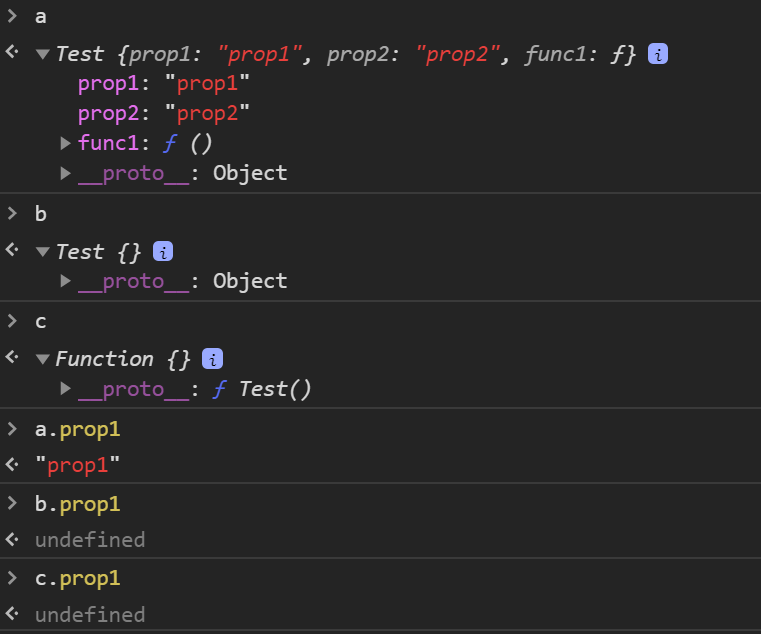
此範例比較三個不同的建立方式:

1
2
3
4
5
6
7
8
9
10
11
12
13
14
function Test(){
this.prop1 = 'prop1';
this.prop2 = 'prop2';
this.func1 = function(){
return this.prop1 + this.prop2;
}
};

Test.prototype.protoProp1 = 'protoProp1';
Test.prototype.protoProp2 = 'protoProp2';

var a = new Test();
var b = Object.create(Test.prototype);
var c = Object.create(Test);

讓我們來看一下 a ,b ,c 三個物件內容在 console 輸出的結果:
結論

所謂的 Prototype 就是原型,所有函式上面都有預設有一個公開的 Prototype 屬性,而被此建構式新建出來的物件都可以透過 [[Prototype]] 參考連結到這個原型物件上來存取其上的屬性,也就能建立出 類似物件導向概念 的程式。

整理一下本篇中出現的名詞:

  • Prototype

    也就是原型物件。

    所有函式上面都有預設有一個公開的 Prototype 屬性(原型物件)。被函式建立出的物件都可以存取其對應的原型物件。

  • [[Prototype]]

    用來讓物件能夠連結到其原型物件上的一個參考。

    這是一個不允許外部存取的屬性。

  • __proto__

    相當於可存取的 [[Prototype]],為了方便存取 Prototype 而生。

    雖已於 ES6 中列為標準,但為了效能考量還是不建議使用。

參考文獻

  1. https://blog.techbridge.cc/2017/04/22/javascript-prototype/

  2. https://cythilya.github.io/2018/10/26/prototype/

  3. https://ithelp.ithome.com.tw/articles/10194356

  4. https://ithelp.ithome.com.tw/articles/10196639

  5. https://pjchender.github.io/2018/08/01/js-%E7%89%A9%E4%BB%B6%E5%B0%8E%E5%90%91-javascript-object-oriented-javascript/

  6. https://medium.com/@jonathanvox01/understanding-the-difference-between-object-create-and-the-new-operator-b2a2f4749358

  7. https://stackoverflow.com/questions/4166616/understanding-the-difference-between-object-create-and-new-somefunction